How Can Audit Firms Reduce Manual Work and Make AI More Useful in Auditing?
7 min read

How Can Audit Firms Reduce Manual Work and Make AI More Useful in Auditing?
Why reducing repetitive tasks and integrating practical AI assistance into audit workflows matters more than simply adding new software features.
What are the biggest frustrations auditors face with audit software?
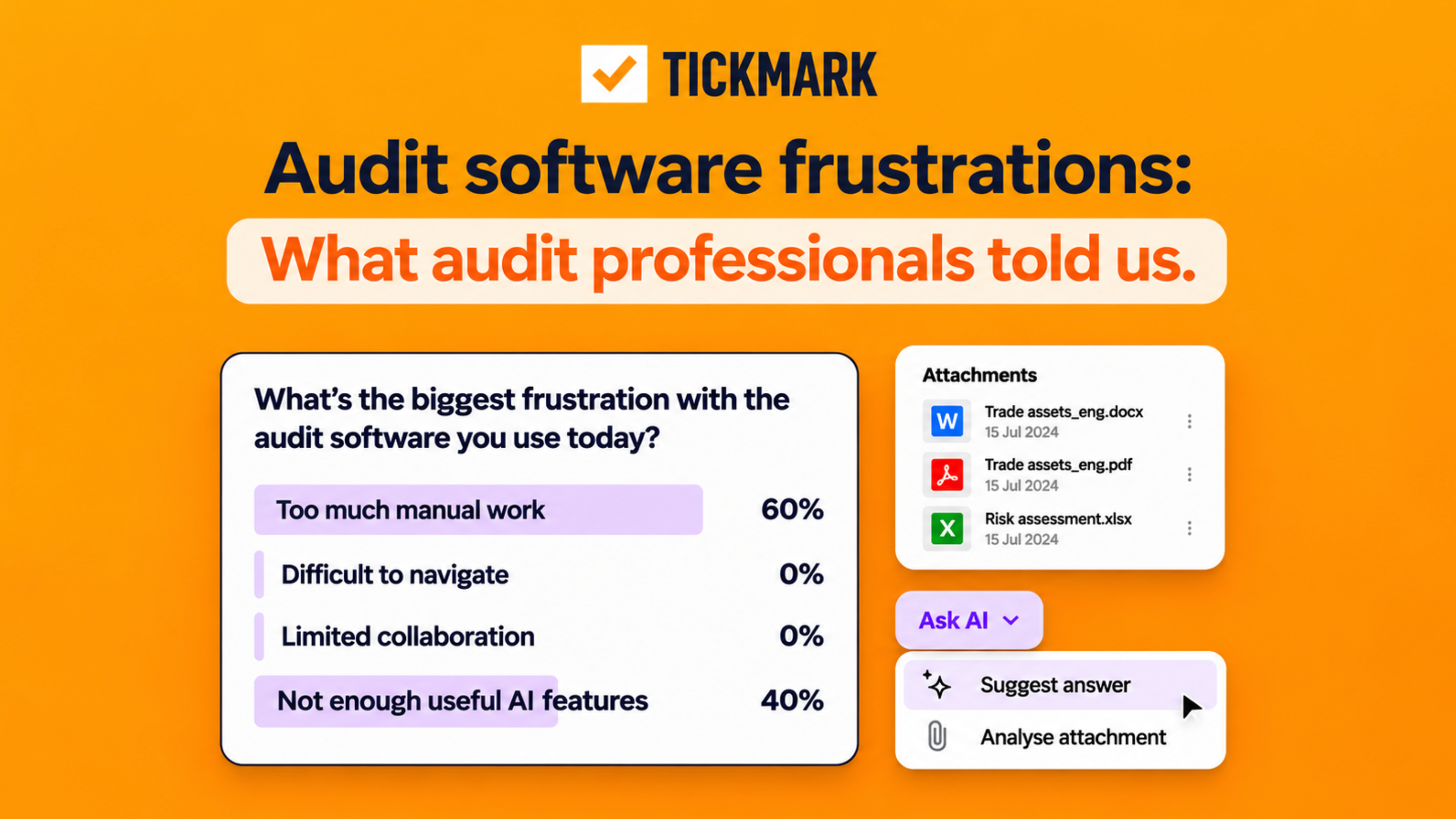
Manual work and a lack of useful AI capabilities are two concerns highlighted by audit professionals in a recent Tickmark LinkedIn poll.
When asked about their biggest frustration with audit software, respondents selected:
- 60%: Too much manual work
- 40%: Not enough useful AI features
- 0%: Difficult to navigate
- 0%: Limited collaboration
The poll had a small number of participants, so these results should not be interpreted as representative of the wider audit profession. However, they raise an important question: are audit software solutions helping professionals work more efficiently, or are they simply adding more tools to an already complex process?
For audit firms looking to improve efficiency, the answer may lie in reducing repetitive tasks and making AI assistance available where auditors actually need it.
Why does manual work remain a challenge in auditing?
Audit engagements involve extensive documentation, planning, evidence gathering and review procedures.
While these activities are essential to maintaining audit quality, not every task requires the same level of professional judgement.
Auditors may spend considerable time organising working papers, transferring information between documents, managing attachments, updating engagement statuses and repeating similar administrative activities across different clients.
When these processes are fragmented, they can create unnecessary duplication and make it more difficult for teams to maintain a clear overview of their engagements.
The challenge is not to eliminate documentation or professional review. It is to make the supporting processes more efficient.
For example, a structured workflow can help auditors access relevant working papers, track outstanding procedures and manage supporting documentation without repeatedly switching between disconnected systems.
This allows more attention to remain on evaluating evidence, identifying risks and exercising professional judgement.
How can audit firms reduce repetitive manual work?
Reducing manual work begins with identifying which activities consume time without adding proportional value to the audit process.
There are several areas firms can evaluate.
1. Standardise audit documentation
Using consistent working paper templates can reduce the need to recreate documents for every engagement.
Standardisation also helps teams maintain a consistent approach to documentation while allowing appropriate adjustments for individual client circumstances.
2. Centralise engagement workflows
Managing engagement activities within one structured environment can improve visibility across procedures, responsibilities and completion statuses.
This becomes particularly useful when multiple team members contribute to the same engagement.
3. Improve document management
Supporting files and audit evidence should be easy to locate, organise and associate with the relevant procedures.
A structured approach to document management can reduce unnecessary searching and duplication.
4. Identify appropriate opportunities for AI assistance
AI tools can support selected activities such as drafting initial documentation, summarising information and analysing supporting materials.
However, their usefulness depends on how well they fit into the auditor's existing workflow and how effectively their outputs can be reviewed.
The objective should be to reduce unnecessary administrative effort without compromising audit quality.
What makes AI genuinely useful in audit software?
Useful AI in auditing is not simply about having a chatbot or generating text.
Its value depends on whether it supports actual audit procedures, works with relevant engagement information and helps professionals complete tasks more efficiently.
Consider an auditor reviewing a working paper.
If AI assistance is available within the same workflow, the auditor may be able to request a suggested response or assistance with an attachment without moving to a separate application.
This can make AI more practical than a disconnected tool that requires users to repeatedly copy information between systems.
AI can potentially support:
- Preparing initial drafts of audit documentation
- Summarising relevant information
- Analysing supporting attachments
- Assisting with repetitive documentation activities
- Providing contextual guidance during audit procedures
These activities still require appropriate human review.
AI generated information may be incomplete, inaccurate or unsuitable for a particular engagement. Auditors must evaluate the reliability and relevance of outputs and remain responsible for their professional conclusions.
The goal is to support professional judgement, not replace it.
How does Tickmark Software combine structured workflows and AI assistance?
Tickmark brings engagement management, working papers, document handling and AI assisted functionality into one platform.
Rather than treating AI as a separate activity, Tickmark provides assistance within the audit environment.
Its available capabilities include:
Structured engagement workflows
Teams can organise procedures, monitor progress and maintain visibility across engagement activities.
Standardised and customisable working papers
Auditors can work with structured documentation while adapting procedures to relevant engagement requirements.
Ask AI
Auditors can access AI assistance while working through relevant procedures, including options to suggest answers and analyse attachments.
AI Auditor
Tickmark's AI Auditor provides additional AI assistance for supported audit activities.
AI Support Bot
Users can access guidance when they need help navigating or using the platform.
These features are intended to reduce unnecessary administrative effort and make AI more accessible within everyday audit workflows.
They do not replace the auditor's responsibility for reviewing evidence, applying professional scepticism or reaching appropriate conclusions.
Can AI improve audit efficiency without compromising quality?
AI can support audit efficiency when firms introduce it with appropriate controls, professional oversight and clear expectations.
Before adopting AI capabilities, audit teams should consider several questions.
Does the tool address a real workflow problem?
Can auditors understand and review its outputs?
Is relevant client information handled appropriately?
Does the tool support existing quality management procedures?
Can the firm assess whether the technology actually saves time?
The answers matter more than the number of AI features available.
An AI capability that reduces a repetitive task while maintaining appropriate professional review may provide more practical value than several features that auditors rarely use.
Frequently asked questions
What tasks can be automated in an audit?
Selected administrative and documentation activities may be automated or supported by software, including working paper preparation, document organisation, engagement status tracking and certain information processing tasks. The suitability of automation depends on the engagement and the firm's quality requirements.
How is AI used in auditing?
AI can assist with drafting documentation, summarising information, analysing attachments and supporting selected audit procedures. Its outputs require appropriate professional evaluation and review.
Can AI replace auditors?
AI cannot replace the professional responsibilities of auditors. Audit evidence, risk assessment, professional scepticism and audit conclusions require qualified professional judgement and oversight.
What should audit firms look for in AI audit software?
Firms should evaluate workflow integration, documentation capabilities, data security, output reviewability, usability and whether the software addresses genuine operational challenges.
How can audit firms measure improvements in efficiency?
Firms can compare the time spent on selected procedures, repetitive documentation activities, engagement preparation and review processes before and after introducing new workflows or technology. Efficiency measures should be considered alongside audit quality.
The future of audit efficiency is about better workflows, not simply more features
Tickmark's LinkedIn poll highlights two concerns worth exploring further: reducing manual work and making AI genuinely useful.
Although the findings are limited to a small group of respondents, the underlying questions are relevant to any firm reviewing its audit processes.
Which activities are taking unnecessary time? Where could documentation become more consistent? And how can AI support auditors without introducing additional complexity?
For firms evaluating their technology, these are useful questions to start with.
Explore how Tickmark Software brings structured audit workflows and practical AI assistance together.
Share on


Put structured audit workflows into practice
See how Tickmark helps teams standardise workpapers and simplify audit reviews.
Explore Tickmark